
The Lady Goes Back to Laos, Part 2
- Pippa

- 9 hours ago
- 8 min read
TUESDAY:

I have a red and orange saisin knotted around each wrist. While chanting blessings at day’s end, a monk at Vat Pasalao tied them on. The one on the right wrist is for safety; the one on the left for luck. I couldn’t help but think we should have started the day at the temple before I set out with my guide, Mr. Soubahn, to explore Champasak and the ruins of Vat Phou. Keep reading.
There were some of those local stubby bananas sitting on the console inside Mr. Soubahn’s roomy truck cab when he met me on our first morning together. “From my garden”, he announced, and I knew we’d get along over the next two days if we could talk about growing food. He grew up in Pakse so he was knowledgeable about life in this region of Laos. As we drove south along the road that connects Pakse to Vat Phou, he told me he had spent his career developing rural policy in the Lao prime-minister’s office in Vientiane.
He pointed out rice fields - green, lush, swaying in the wind - and informed me that this part of the countryside plants two crops of rice each year. Beyond them, limestone karst rises in rugged contrast to the soft meadows. Foraging cattle wandered on and off the road seemingly indifferent to any danger from passing vehicles. Mr. Soubanh said they return home at nightfall because they know they are going to get a treat – sticky rice Who would have thought? I caught myself wondering if each cow gets a little bamboo basket with its daily ration.
The iconic shape of Phou Kao mountain comes into view as we approach Vat Phou, the UNESCO World Heritage Site that is our destination this morning. Supposedly, the mountain takes the form of a hairstyle worn by Lao women but, given its Hindu name -Lingarawata -I can immediately see the lingam shape that would have made the place spiritually significant for the original Hindu temple builders during the Khmer Empire
Another reason for building the temple complex under Phou Kao was the presence of a water source, considered across the centuries to be imbued with sacred properties. If we manage to climb up to “Paradise” today to where the holy water spurts from the mountain, Mr. S. will collect some to take back to his mother in Pakse.
But first a stop at Wang Champa, the unfinished palace of the Last Prince of Champassak, for a cup of “nearly-royal coffee” as at least one commenter has observed. It wasn’t really clear as to who exactly manages the 50 year old building given that much of it is derelict. But the coffee shop is operational and serves us tasty cappuccino that we consume in what appear to be authentic art deco rattan deck chairs out on the verandah. Sitting there, I ponder the mindset of a person who would set about constructing a palace while American bombs were exploding all around and the Pathet Lao communists were drawing up plans for the future Lao People's Democratic Republic
A few kilometres south we enter what was once the Khmer city of Shestrapura—now part of the Vat Phou World Heritage Site. Mr. Soubahn recounts local folklore of man-eating ogres, unconditional love, and peasant boys with magical powers. The road skirts the Mekong, carrying us past traditional stilted Lao houses next to weathered colonial buildings, Khmer archaeological sites, and Buddhist temples—all protected by UNESCO. Mr. S gestures to the left and tells me that’s the road we’d take if we wanted to drive to Angkor Wat in Cambodia. Today, though, we’re here for Vat Phou, a temple complex that predates Angkor Wat by several centuries.

We explore the museum first, then begin our climb among the ruins toward “Paradise,” the uppermost sanctuary once reserved for royalty. To reach it we have to ascend seven terraces, each with eleven steps. “Like Seven Eleven,” Mr. S jokes, but I’m focused on seventy-seven uneven stone steps and the pressing heat. I’m also wishing I'd worn running shoes for this outing. I glance around for an easier route, but there are no handrails and no alternative paths—just the stairs. I tell myself the weeks I’ve spent at the gym will pay off. I drain the rest of my water (less to carry, right?) and start up.
Just as my foot reaches the eleventh step on terrace five, I pitch forward. I catch myself, but not before my right shin scrapes the rock through the fabric of my skirt. I wince as I straighten up and feel Mr. S’s hand steadying my elbow. One deep breath to keep going and I make it to the top, but I still don’t look at the damage—my knee is throbbing too hard. We’ve run out of water, but Terrace 11 holds the sacred spring, and I’m counting on at least a trickle to rinse my leg. A few minutes later up against the steep rock face,
we can see where the water is dribbling out of the mountain. We take turns collecting water in our empty bottles. Mr. S doesn’t recommend drinking it but I don’t hesitate to sluice the cool liquid over my scraped knee. Holy or not it stings.

It takes us about 40 minutes of careful limping to return to the car park pausing several times to take in the view across the fields towards the Mekong River. Once you’re below and looking back up at Paradise you can truly appreciate the full scale of the mountain-temple layout that unfolds along the slope.
We drive back through Champassak and stop for a mid-afternoon lunch of fish on a riverside verandah. Small boys are cavorting below us in the Mekong while, further out, a long-tail boat trolls up and down with its fishing lines. Across the water we can see the sandy beaches of one of the resort islands but with the Buddhist New Year still a few weeks away the resorts aren’t very busy at this moment. In fact, we’re the only people having lunch at this restaurant.
By the time we reach the Golden Buddha at Phousalao temple my right knee is royally throbbing, Here, at our final stop of the day, Mr. S. introduces me to the monk - the man I should have gone to meet to ask for blessings before we ever set out this morning!
WEDNESDAY:
My knee feels better—or so I tell myself. In fact, it’s still very tender, so I carefully re-medicate it before getting ready for a day on the Bolaven Plateau. Today we’re going to see waterfalls and coffee plantations. Mr. S arrives earlier because we have a longer drive ahead. As I climb into the truck cab, trying not to wince, he hands me a small bag of mangoes from his garden. There are more bananas, too, for our snacking pleasure. We are all set.
The sky is still hazy at our first stop, Tad Fane, but the viewing platforms give us a clear view of the twin waterfalls, which gush out of the cliff face as they plunge 300 metres into the jungle below. My leg is too sore to contemplate a zip-line view of the scenery, so we wander around the resort for a while and then get back on the road.

Coffee time. Our next destination is a small local coffee producer. Lak 40 has, in fact, just won first place for its washed Arabica coffee, and we find the owner and general factotum, South (pronounced soot), up a ladder “cleaning” a coffee tree. This is her family’s farm, and with the help of a few workers she has been overseeing the picking and roasting of the cherries—as I learn to call them—for many years. She hops down the ladder, asks to see the photos I’ve taken of her, and then poses for a few more. I like this lady; she’s feisty. We sample the farm’s famous white tea before moving on to a cup of award-winning Arabica. Mr. S and South chat back and forth as more visitors arrive, eager to learn about coffee cultivation.
Next, it’s on to Tad Yeuang (Nguang), a twin-tiered waterfall just up the road from South’s farm. There’s no zip-line here, but there are steps, so down we go. The word yeuang refers to a goat-like animal—the serow—that was once seen here. Mr. S points up to a cave and suggests we watch to see if the serow returns, but I’m more interested in the people frolicking in the pool at the base of the falls and envious because I didn't bring my swimsuit. I can’t remember how many steps we have to climb to reach the top, but it feels like a lot in the heat.
Then it’s back up the highway. We pass the derelict building on the left that once housed the coffee research facility established by the French in the early 20th century, when they realized that the volcanic soil of the Bolaven Plateau, combined with the cooler temperatures and higher altitudes, made it ideal for coffee cultivation. We stop at a huge plantation that I recognize from the many selfies my former students have posted on Facebook with forests of coffee trees in the background and I pose for a photo there too. The giant coffee producers have their place in this economy also but the visitors to South's small holding are more connected to the process of coffee growing.
In Paksong we pass the bombed-out shell of an office building and Mr. S tells me that

the former electrical plant was another casualty of the Secret War– when the USA dropped a full planeload of bombs on Laos every 8 minutes, 24 hours a day for 9 straight years. About 200 employees of the Paksong electrical company were killed by some of those bombs in 1971. Today the building houses the CC 1971 Café and the ruins, along with some rescued artefacts, tell the rest of the story. Post-apocalyptic seems a bit clichéd but it’s hard to think of any other way to describe the setting.
My ears are popping as we descend towards Pakse after lunch . We're 1,300 metres above sea level here. There are very few vehicles on the highway because another war has driven fuel prices so high. We make it in time to Pakse to take a quick tour around the Champa Palace Hotel. This building was supposed to be the city residence of The Last Prince of Champasak (see above) but he couldn’t take it with him when he had to flee the country in 1975. Eventually, the building was restored with massive amounts of gold trim (I can think of one politico who’d feel right at home here.) and re-opened as a luxury heritage hotel in the late 1990s. Situated on the banks of the Xe Don river, the rooftop verandahs look out across Pakse and its many bridges. In the distance, the sun is beginning to slip toward the Mekong and the city softens around us…sao sao – slowly, slowly – sao sao.
THURSDAY:
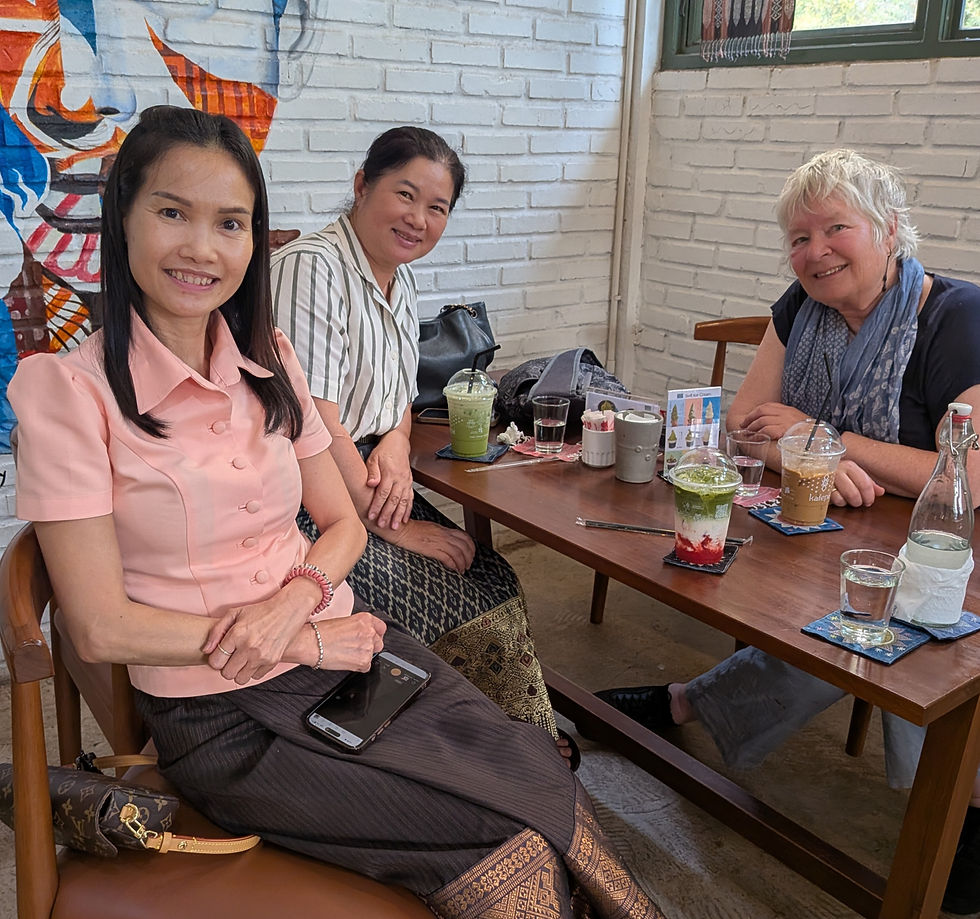
Nothing planned for today except an early afternoon return flight to Vientiane. I settle down after breakfast to do some lesson planning for my Afghan girls. A message comes through on my phone from Ms. K, Mr. S’s daughter who runs an English language school in Pakse. It seems that Mr. S has passed along my interest in volunteer teaching because she’s offering me a placement when I’m ready to return to Laos. What a wonderful note to leave on! Grinning like a fool, l I finish packing, check out and take a tuktuk back to the airport. I’d skip with excitement if I could but that knee is still tender. While I’m sitting in the departure lounge, Ms. T texts from Vientiane. She won’t take no for an answer and will be meeting my flight later on. Sure enough, there she is beaming a welcome across the arrivals area before whisking me out to the air-conditioned comfort of her vehicle. We are going to meet one of the other M2 students for a final coffee together. I tell her to slow down – there’s nothing final about this good-bye. I’ll be back next year.


I trust that you have no lingering knee discomfort Ms P.
Ms C